
Introduction
RustQC is a fast quality control toolkit for sequencing data, written in Rust. It reimplements several established bioinformatics QC tools as a single compiled binary with no runtime dependencies:
- dupRadar — RNA-seq PCR duplicate rate analysis
- featureCounts — gene-level read counting and biotype quantification
- RSeQC — 7 RNA-seq quality control modules (bam_stat, infer_experiment, read_duplication, read_distribution, junction_annotation, junction_saturation, inner_distance) plus TIN (Transcript Integrity Number) analysis
- preseq — library complexity extrapolation (lc_extrap)
- samtools — flagstat, idxstats, and stats SN-section compatible outputs
- Qualimap — gene body coverage profiling and RNA-seq QC summary
Why RustQC?
Section titled “Why RustQC?”RNA-seq quality control typically involves running multiple tools written in R and Python, each with their own dependencies, interpreters, and runtime overhead. RustQC consolidates these into a single fast binary.
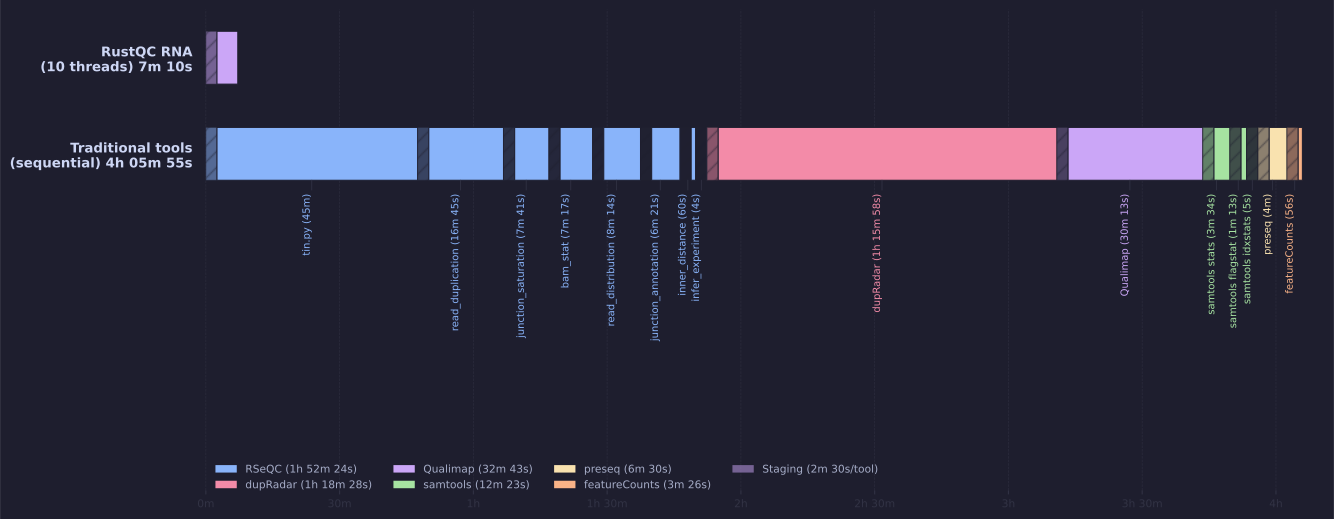
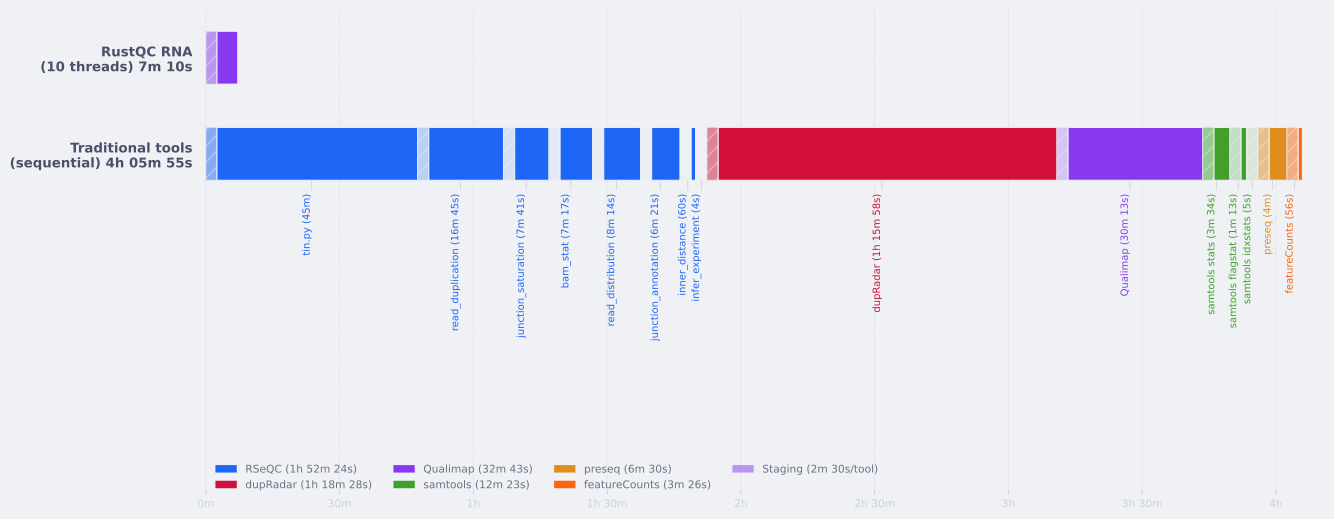
Run time for a 10 GB paired-end BAM (dupRadar + featureCounts + RSeQC + preseq + samtools + Qualimap)
Key advantages:
- Speed: Up to 21x faster than the traditional R/Python workflow
- Single binary: No runtime dependencies — no R, Python, or Bioconductor installation required
- Single-pass architecture: The
rnasubcommand performs read counting and duplicate analysis simultaneously, eliminating the need for a separate featureCounts run - Identical output: Produces bit-for-bit identical results to the original tools (verified across 820,000+ values with zero mismatches for dupRadar)
- Multiple input support: Process several BAM files in a single command with automatic parallelisation
- Modern format support: Accepts SAM, BAM, and CRAM input files; annotation files (GTF and BED) can be plain or gzip-compressed
Available tools
Section titled “Available tools”rustqc rna — RNA-Seq quality control pipeline
Section titled “rustqc rna — RNA-Seq quality control pipeline”Given a duplicate-marked BAM file and a GTF or BED12 annotation, rustqc rna runs all of the following in a single pass:
- Counts reads per gene (equivalent to Subread featureCounts)
- Computes duplication rates per gene at multiple counting levels (dupRadar)
- Fits a logistic regression model relating expression to duplication rate
- Generates diagnostic plots: density scatter, boxplot, and expression histogram
- Produces MultiQC-compatible reports for integration into analysis pipelines
- Outputs featureCounts-format files including biotype-level summaries
- Estimates library complexity via extrapolation (preseq lc_extrap equivalent)
- Computes Transcript Integrity Number (TIN) for RNA degradation assessment
- Profiles gene body coverage with Qualimap-compatible output
- Produces samtools-compatible outputs (flagstat, idxstats, stats)
RSeQC tools — RNA-seq quality control
Section titled “RSeQC tools — RNA-seq quality control”Seven reimplementations of RSeQC tools, plus TIN analysis, all integrated into the rustqc rna command and running automatically in the same single-pass analysis:
| Tool | Description |
|---|---|
| bam_stat | Basic BAM alignment statistics (total reads, duplicates, mapping quality, etc.) |
| infer_experiment | Infer library strandedness from read/gene-model strand concordance |
| read_duplication | Position-based and sequence-based read duplication histograms with plots |
| read_distribution | Classify reads across genomic features (CDS, UTR, intron, intergenic) |
| junction_annotation | Classify splice junctions as known, partial novel, or complete novel, with pie chart plots |
| junction_saturation | Assess saturation of splice junction detection at increasing read depths, with plot |
| inner_distance | Compute inner distance between paired-end read mates, with histogram plot |
| tin | Transcript Integrity Number (TIN) for RNA degradation assessment |
Additional tools
Section titled “Additional tools”| Tool | Equivalent | Description |
|---|---|---|
| preseq | preseq lc_extrap | Library complexity extrapolation with bootstrap confidence intervals |
| gene body coverage | Qualimap rnaseq | Coverage profile along gene bodies with 5’/3’ bias metrics |
| flagstat | samtools flagstat | Alignment flag statistics |
| idxstats | samtools idxstats | Per-chromosome read counts |
| stats | samtools stats | Summary number (SN) statistics |
When a GTF file is provided via --gtf, all tools run automatically — transcript-level structure is extracted from the GTF. Alternatively, a BED12 gene model file can be provided via --bed (mutually exclusive with --gtf), which runs the RSeQC tools, TIN, preseq, and samtools outputs, but skips dupRadar, featureCounts, and gene body coverage (they require a GTF). Both GTF and BED files can be provided plain or gzip-compressed (.gz) — compression is detected automatically. Individual tools can be disabled via the YAML configuration file.
Credits
Section titled “Credits”RustQC stands on the shoulders of the original tools. If you use RustQC, please cite dupRadar, Subread/featureCounts, RSeQC, and preseq. See Credits & Citation for full details.